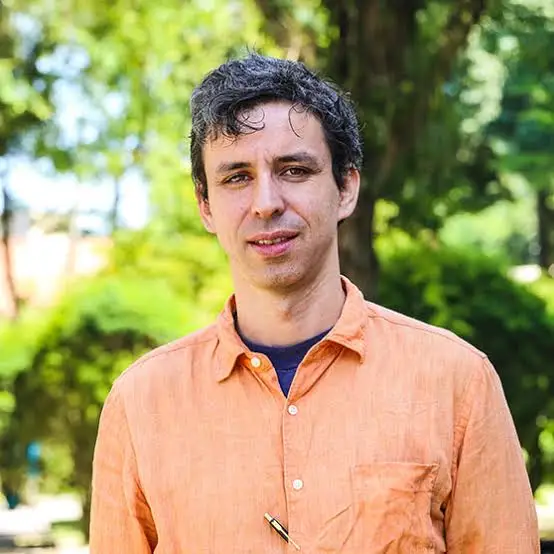
Learn more about the research:
Not only the pattern of photons that reaches the eyes is important for our visual perception. The expectation created by our brain about what is going to arrive is no less important. There is a richness of internal processes that filter, organize, integrate, and construct perception. At some point, the dynamics of these processes emerge as an awareness of the world. As a neuroscientist, I am interested in understanding some of the neural mechanisms that enable perception to organize and emerge.
The raw material for our vision consists of perturbations in the electromagnetic field, manifested through photons that reach the retina with varying frequencies and statistical properties. In this interaction between a massless particle and our photoreceptors, a cascade of biophysical and neurophysiological reactions is triggered, propagating through different neural pathways in our brain. The most fundamental question we seek to investigate in this Ciência Pioneira project is how the statistics of these photons influence the excitation of photopigments in the retina. For example, does the spatiotemporal distribution of photons interfere with the probability of their absorption? We also explore less orthodox questions: can non-classical correlations between photons (e.g., quantum entanglement) be mapped onto perception?
Publications:
Lima B, Florentino MM, Fiorani M, Soares JGM, Schmidt KE, Neuenschwander S, Baron J, Gattass R. (2023). Cortical maps as a fundamental neural substrate for visual representation. Prog. in Neurobiol. 224: 1-19.
https://www.sciencedirect.com/science/article/abs/pii/S0301008223000242
Lima B, Cardoso MMB, Sirotin YB, Das A. (2014). Stimulus-related neuroimaging in task-engaged subjects is best predicted by concurrent spiking. J Neurosci. 34: 13878–13891.
https://www.jneurosci.org/content/jneuro/34/42/13878.full.pdf
Lima, B, Singer W, Neuenschwander S. (2011). Gamma responses correlate with temporal expectation in monkey primary visual cortex. J Neurosci. 31: 15919-15931.
https://www.jneurosci.org/content/jneuro/31/44/15944.full.pdf
Lima B, Singer W, Chen N-H, Neuenschwander S. (2010). Synchronization dynamics in response to plaid stimuli in monkey V1. Cereb Cortex. 20: 1556-1573.
https://academic.oup.com/cercor/article/20/7/1556/321347