Pioneer Science, the IDOR (D’Or Institute for Research and Teaching), and IMPA (Institute of Pure and Applied Mathematics) have formed a partnership to combine biomedical research with mathematical tools. Formalized through a Memorandum of Understanding (MoU) signed on Friday (12), the collaboration will bring together researchers from the institutions in projects that apply mathematics, computational modeling, and artificial intelligence to challenges in contemporary medicine. Pioneer Science and IDOR will invest 2.5 million over up to three years in the selected projects.
“Pioneer Science believes that relevant scientific advances occur when talents from different areas find space to collaborate. The desire to develop research with IMPA is longstanding, some specific actions had already been established, and now, this step is fundamental to opening new frontiers of knowledge,” says neuroscientist Jorge Moll, the creator of Pioneer Science.
The initiative connects the expertise of the Pi Center (IMPA Projects and Innovation Center) in applied mathematics and machine learning with the experience of Pioneer Science and IDOR in developing biomedical research. The goal is to create new approaches to analyze complex data, enhance the understanding of diseases, and accelerate the generation of knowledge with potential clinical application.
“This partnership creates a collaborative environment where mathematics, artificial intelligence, and computational modeling can contribute to significant advances in understanding diseases and developing new approaches to health. We are very excited about the opportunities that will arise from this collaboration between IMPA, IDOR, and Pioneer Science,” highlighted IMPA’s director-general, Marcelo Viana.
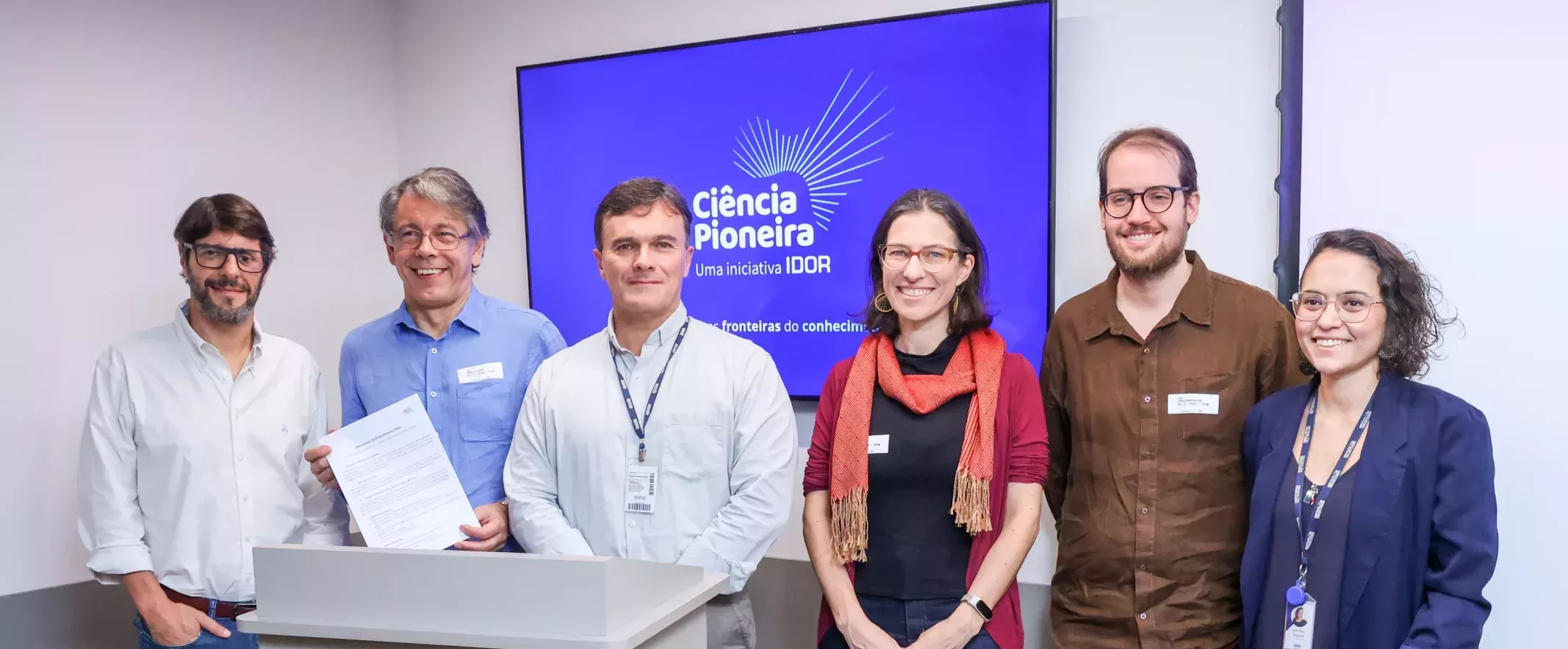
During a meeting held at IDOR’s headquarters in Rio de Janeiro, researchers presented six collaboration proposals. The initiatives cover areas such as cardiology, neuroscience, molecular biology, studies of consciousness, and quantum physics applied to health. See below for details of each research project.
- Artificial intelligence in cardiovascular imaging: the proposal uses machine learning and advanced image analysis to integrate data from cardiac magnetic resonance imaging, clinical exams, and electronic medical records, allowing the construction of predictive models for cardiovascular events and the early identification of biomarkers associated with heart diseases.
- Aging, balance, and neurological diseases: the research investigates how aging and neurological diseases, such as Parkinson’s, affect balance, gait, and motor control. The work integrates neural, biomechanical, and clinical data to develop biomarkers capable of early identifying functional changes and fall risk, using advanced models of artificial intelligence and machine learning.
- Decoding in vitro neural activity: focused on studying Dravet Syndrome, a rare and severe form of genetic epilepsy, the project uses human cellular models and high-complexity electrophysiological recordings to understand the functioning of neural networks and their response to different therapeutic interventions. Mathematical and artificial intelligence tools may contribute to identifying patterns associated with the disease and developing new treatment strategies.
- Neuroscience and cognition: the research investigates how signals of brain activity can be used to reconstruct and understand mental contents, such as perceptions and imagined images. Using functional magnetic resonance imaging data and advanced models of artificial intelligence, the project seeks to relate patterns of brain activity to computational representations, contributing to new tools for studying cognition, emotions, and subjective states.
- Is consciousness computable?: the study investigates non-ordinary experiences of consciousness, such as altered states of perception, intense emotions, and feelings of depersonalization. The proposal combines large population databases, mathematical modeling, and artificial intelligence to identify patterns in these experiences and better understand the brain and cognitive mechanisms involved in human consciousness.
- Neurophysics: the proposal applies mathematics and artificial intelligence to the analysis of data generated by experiments with light and photons, contributing to advances in spectroscopy, imaging, and understanding the mechanisms of human visual perception.
After the presentations, researchers and scientists from IMPA projects discussed collaboration possibilities for each proposal. The next step is to define the projects that will be selected to receive financial support.
The partnership between Pioneer Science, IDOR, and IMPA reinforces the growing integration between mathematics, computing, and life sciences, an area considered strategic for advancing scientific research and precision medicine. The expectation is that the collaboration will generate new analytical methodologies, enhance the capacity to interpret complex data, and accelerate the transformation of scientific discoveries into concrete benefits for society.
Partnership in student training
In addition to the scientific collaboration with the Pi Center, Pioneer Science also has initiatives with IMPA Tech, the undergraduate program of IMPA. Bachelor’s students had the opportunity to participate in a course offered by researchers from the initiative. The course presented ways to apply mathematics and data analysis to science in different areas, connecting theory, practice, and real-world challenges. A new class will be formed soon. And the partnership will be expanded with IMPA Tech students teaching programming to IDOR graduate students.