
By Pioneer Science | Published on December 8, 2025 | Last updated on May 14, 2026
Author: Gustavo Granjeiro
What does it mean to take care of oneself? For many people, it means going to the doctor regularly, taking medication, or having routine exams. But in Brazil, a country marked by a mix of traditions and knowledge, taking care of oneself can also mean lighting a candle, praying, or taking an herbal bath. These are practices that combine health, spirituality, and tradition – and are part of the daily lives of many people.
But, after all, what are the most common practices? And do they usually go hand in hand?
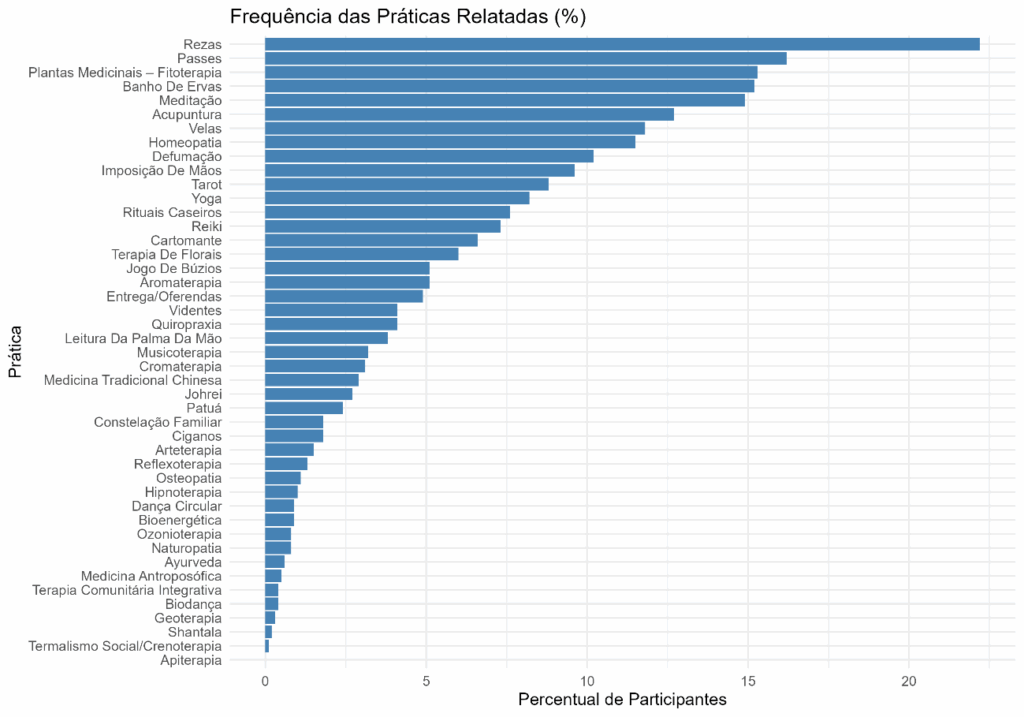
To understand better, we asked more than 2,000 people if they had ever used any of the 45 Integrative and Complementary Health Practices (PICS). The list included meditation, reiki, acupuncture, but also tarot, spiritual passes, and the use of medicinal plants. Then, we used an analysis technique that identifies which practices tend to be used together.
WHAT WE DISCOVERED
The most common practice was prayer, adopted by 22.2% of the sample. Next came spiritual passes (16.2%), medicinal plants (15.3%), herbal baths (15.2%), and meditation (14.9%). These numbers show how care in Brazil mixes faith, tradition, and well-being.
But that’s not all. We also found patterns of co-occurrence, that is, practices that tend to be done together. For this, we used a technique that groups practices based on the frequency with which they appear combined and highlighted in the graph below the most common ones for Brazilians.
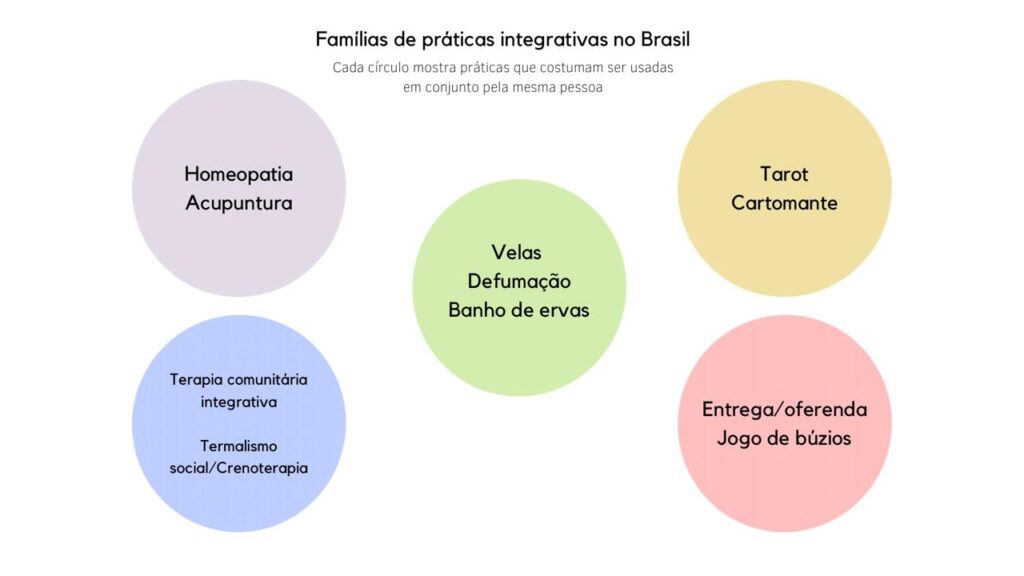
These groupings reveal distinct styles of care, based on cultural, spiritual, or functional affinities. Some examples:
– Those who light candles often also perform smudging and herbal baths.
– Those who consult tarot often also resort to cartomancy.
– Those who make offerings tend to throw shells.
– Those who use homeopathy often do acupuncture.
– Those who participate in Integrative Community Therapy also seek Thermalism or Crenotherapy.
These combinations form “care packages” that express ways of living well-being in a holistic care. In some cases, they are linked to religious traditions; in others, to ways of dealing with suffering outside conventional medicine to alleviate symptoms.
WHY DOES THIS MATTER?
This data helps reveal a Brazil where faith, tradition, and care intertwine. If we want to build more inclusive public policies, it is essential to recognize these forms of therapeutic approaches, even if they do not replace traditional treatments. Ultimately, taking care of oneself is also a gesture of connection with the environment and society, something that gives meaning to life.


