

By Pioneer Science | Published on October 8, 2025 | Last updated on May 14, 2026
Article in the series that explores the context of extraordinary experiences in Brazil and how they impact our population. All data were collected and related from studies conducted by the Beliefs and Values Neuroscience group at the D´or Institute of Research and Education.
Author: Maria Clara Laport
It is common, when we think of “extraordinary experiences,” for unconventional occasions to come to mind, such as feeling invisible presences and changes in self-perception. However, an emotional experience that stands out from others can also be extraordinary, whether due to its intensity or uniqueness.
Emotions are a fundamental part of the human experience. They influence behaviors, decisions, and social relationships, as well as reflecting cultural and contextual aspects of a population. They shape how we interpret the world and often guide our life choices.
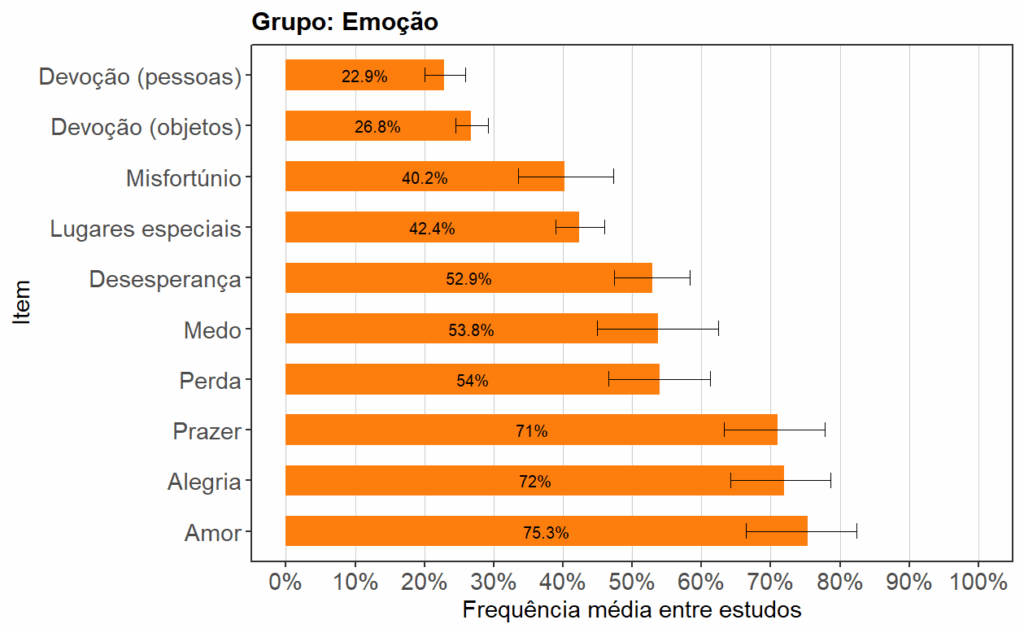
Figure 1
In the research conducted by IDOR, with support from the John Templeton Foundation, we acquired data from over 20,000 people who, among other various topics, also responded about their emotional experiences. More than 70% of participants had significant experiences related to positive emotions, such as love, joy, or pleasure.
Negative experiences also occupy a relevant space. More than half of the people reported having experienced some loss, fear, or hopelessness, and about 40% mentioned experiences of misfortune. These data demonstrate how moments of pain and adversity can also stand out as extraordinary, leaving deep marks in our memory.
Beyond these more “common” emotions, the group of emotions also includes experiences of devotion – directed towards people (22.9%) or objects (26.8%) – and connection with special places (42.4%), reported by a smaller portion of participants.
THE COMPLEXITY OF HUMAN CONNECTION
Although less frequent, these experiences point to something very unique to humans: the ability to create emotional bonds. These bonds sometimes do not involve other living beings or people in our lives. Thus, an object can become a guardian of memories and affections, a distant figure (like an idol or a saint) can evoke a feeling of surrender and trust, and even a place never visited can generate an inexplicable sense of belonging.
These results show that the extraordinary dimension of emotions is not limited to the most universal ones, such as love or joy. It also manifests in experiences that reveal the depth of our capacity to create meanings and connect with the world.
To continue exploring the universe of extraordinary experiences, don’t miss the upcoming articles in our series!


