

By Pioneer Science | Published on September 2, 2025 | Last updated on May 14, 2026
Eighth article in the series exploring the context of non-ordinary experiences in Brazil and how they impact our population. All data was collected and related from studies conducted by the Neuroscience of Beliefs and Values group at the D´or Institute of Research and Education.
Author: Mirta Misailidis
Think about the last time the world seemed to stop for a moment. Have you ever looked at a sky full of stars and felt, at the same time, tiny and connected to something grand? Or heard a song that gave you chills and silenced all your thoughts? This is the feeling of awe.
This feeling does not have an exact translation into Portuguese, just like the word “Saudade” in other languages. It can be translated as wonder or amazement; it is the “wow!” moment — of admiration or contemplation — in the face of something greater, unknown, or inexplicable.
Awe is more than a pleasant feeling. Although it is often compared to the feeling of admiration and includes related states such as inspiration and elevation, studies also show that about 20% of awe experiences can be tinged with fear. Therefore, if the experience of awe is so personal and “hard to describe,” how is it possible to scientifically study the “ingredients” that make up awe and understand why it is so impactful?
THE RESEARCH
To uncover this, IDOR conducted a survey in which volunteers responded to a list of phenomena from the Inventory of Non-Ordinary Experiences – INOE, indicating with “yes” or “no” which experiences they had already lived. The survey focused on deciphering the “recipe” for awe and what other “ingredients” were present when the key item appeared.
If a participant reported feeling awe, the next question was directed at the time when these phenomena occurred, in order to discover if any of these previously experienced events happened at the same time as the key item. This approach allowed for the recording of not only isolated ingredients but also how they combined to form the link of a memorable moment.
By cross-referencing thousands of responses and analyzing which ingredients appeared at the same time, more frequently, the sensations, perceptions, and feelings that form the ecosystem of awe were mapped. The most striking finding was revealing the fingerprint of awe.
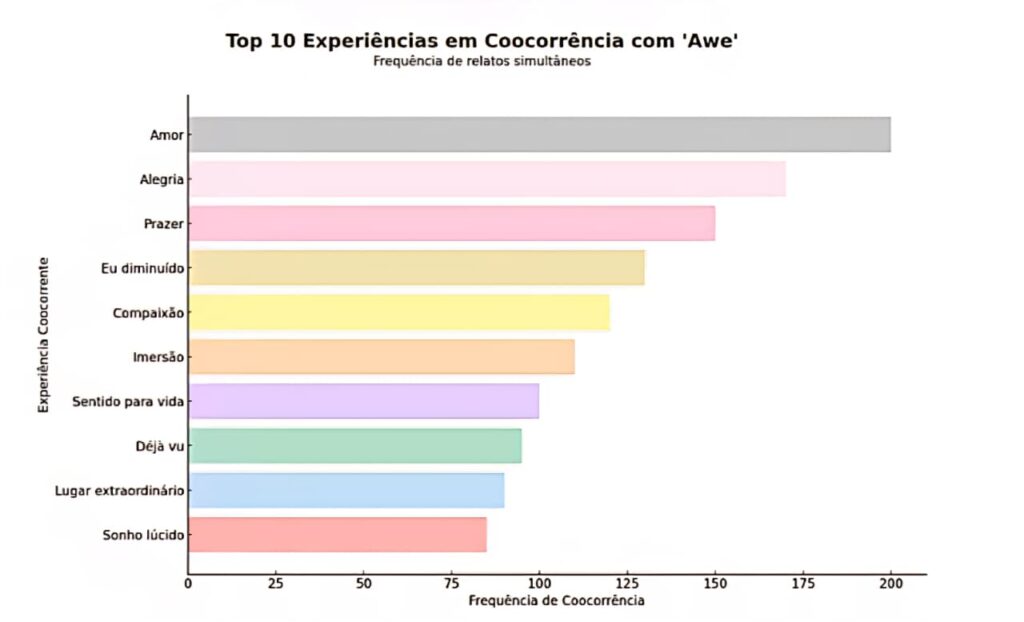
Figure 1
THE RESULT
The analysis of the “fingerprint” of awe revealed which experiences form its core. The result presented in Figure 1 shows the frequency of experiences that were reported together, revealing new perspectives on what constitutes the “wow!”, such as:
Positive Emotions: Love, joy, and pleasure form the emotional foundation of the experience.
The Diminished Self: The striking feeling that the individual “self” becomes smaller in the face of something vast.
Deep Absorption: A state of absorption so complete that the perception of the passage of time is altered.
Connection and Meaning: Feelings of compassion, the perception of a greater meaning for life (Meaning for life), and unity with the universe.
Perceptual Phenomena: Experiences such as déjà vu, lucid dreaming, and the feeling that certain places have a greater power or force (Extraordinary place), confirming that awe impacts our perception of reality.
Feelings of unity with the universe and deep peace are constant companions of awe. But the analysis allowed for going beyond this list. By studying how all experiences relate, it was possible to discover that they organize into a true ‘map of the mind‘, identifying ‘families’ or ‘constellations’ of sensations.
The main ‘family’ that orbits around awe is made up of positive transcendental experiences, uniting peace, unity, and positive emotions. A second family, more related to perceptions, groups changes in the perception of time. This shows us that the ‘wow!’ is not just a feeling, but a complex event that momentarily reconfigures our perception and emotional state.
WHY IS IT IMPORTANT TO KNOW THE ANATOMY OF AWE?
Admiration is a response to different stimuli that are still not well understood by individuals, which can give rise to mixed and complex emotional states. Neuroscience says that awe quiets the parts of the brain related to the ego, making us more connected to others. Studies such as those by psychologist Dacher Keltner show that awe experiences are linked to greater generosity, humility, and overall well-being. They shift the egocentric focus and connect individuals to something greater than themselves.
Thus, studying transcendental emotions, including awe, has important implications for understanding the functions and structure of emotion in general. Inducing admiration — whether through contact with grand landscapes, works of art, or moments of unexpected beauty — can profoundly impact levels of life satisfaction and well-being. These activities can be a crucial practice for the “wow!” moment, reigniting the connection with the world and with oneself.


