
By Pioneer Science | Published on July 28, 2025 | Last updated on May 14, 2026
Fifth article in the series that explores the context of non-ordinary experiences in Brazil and how they impact our population. All data were collected and related from studies conducted by the Neuroscience of Beliefs and Values group at the D´or Institute of Research and Education.
Author Pedro Fortes
During sleep or in states of deep relaxation, some people have the sensation of floating outside their body (called “out-of-body experience” or OBE), as if they could observe themselves from an external point of view, commonly seen from above. At other times, in stressful situations or during spiritual practices, they may feel that they merge with another person, an object, or even with the universe, as in intense mystical experiences. Similarly, there are experiences of diminishment or dissolution of the self, where there is a partial or total disruption of the notion of “I” and narrative identity. We refer to these peculiar phenomena as experiences of alteration of the self and identity, characterized by a change in the perception of the usual boundaries between ourselves and the external world.
As we discussed last week, the Inventory of Non-Ordinary Experiences (INOE) represents an important methodological alternative for studying this type of phenomenon, as it offers the possibility to measure non-ordinary experiences based on their subjective descriptions, without the interference of predefined theoretical and cultural interpretations. The Brazilian version of the inventory, adapted by the Neuroscience of Values and Beliefs group at IDOR, consists of 37 items organized into different conceptual categories. Next, we will specifically look at some prevalence data on the category “alterations of the self,” which includes: absorption, diminishment of the self, and out-of-body experiences (OBEs).
PREVALENCE DATA
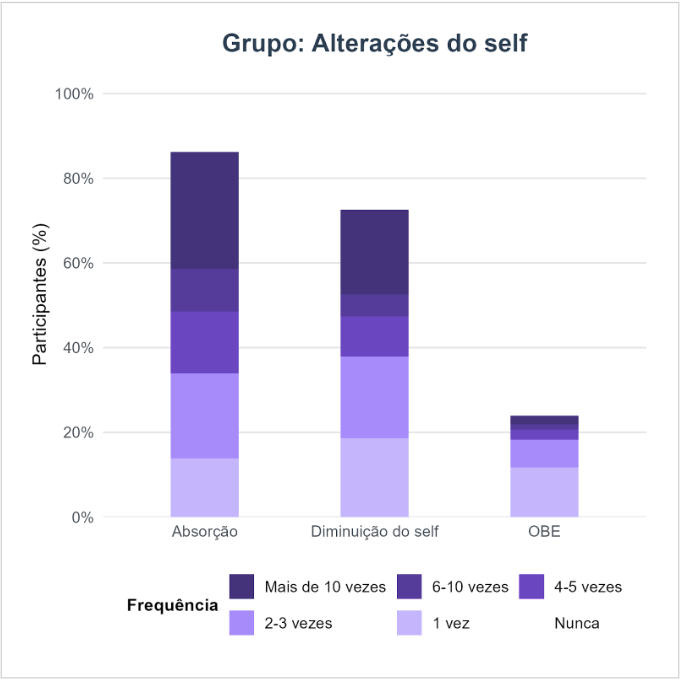
Image 1. The bar graph indicates the average frequency among the combined participants of the 6 studies for the experiences of “Absorption,” “Diminishment of the self,” and “OBE.”
From the data obtained with 6 distinct samples, it was possible to estimate the average prevalence of these experiences in the Brazilian population. It was observed that, at least once in their lifetime, more than 80% of participants have experienced absorption, while 27.6% have had this experience more than 10 times. Regarding the experience of diminishment of the self, 72.6% of participants reported having experienced it at least once in their lifetime, while about 20% indicated that they have felt this more than 10 times.
Finally, out-of-body experiences were reported as the least frequent in the group, yet still reported by almost one-fifth of participants. More uncommon, OBEs tend to occur less frequently in the lives of those who experience them, and only 2% of people reported having had the experience more than 10 times – which is still a quite significant number when generalizing these estimates to the Brazilian population. These numbers suggest that alterations in the perception of the self are, in general, highly prevalent in Brazil.
IMPACTS ON HEALTH
Research indicates that these experiences may be linked to changes in neurological activity – for example, in areas such as the temporoparietal junction – associated with the perception of the body, space, and self. Additionally, people with a pronounced presence of psychological traits such as fantasy and permeable mental boundaries are predisposed to report more non-ordinary experiences of the self and identity. As for contextual factors, it is known that situations of intense stress, sensory deprivation, religious ritualistic contexts, deep meditation, or substance use (such as ketamine) can also trigger these experiences.
Although often studied in the context of dissociative phenomena and their diagnostic implications, these experiences can occur without necessarily causing suffering or functional impairment. On one hand, some theories explain these phenomena as failures in the integration of bodily sensations and the sense of “I,” while others emphasize the idea that self experiences may be associated with adaptive mechanisms and trigger positive processes for mental health. Both in therapeutic and religious contexts, for example, alterations in the perception of the self can produce feelings of self-transcendence, strengthen social connection and empathy, as well as allow alternative forms of resolving psychic conflicts.
In the upcoming articles, we will explore a bit more about different groups of experiences based on studies with the Inventory of Non-Ordinary Experiences. Until next time!


