

By Pioneer Science | Published on July 4, 2025 | Last updated on May 14, 2026
Second article in the series that explores the context of non-ordinary experiences in Brazil and how they impact our population. All data were collected and related from studies conducted by the Neuroscience of Beliefs and Values group at the D´or Institute of Research and Education.
Author Luiza Tavares
With the support of the John Templeton Foundation and in partnership with Pioneer Science, a research conducted by the Neuroscience of Beliefs and Values group at the D’or Institute of Research and Education (IDOR) collected the accounts of 5,117 Brazilians from all regions of Brazil to investigate situations and individual experiences that escape the ordinary. In the previous article, relevant data on the prevalence of non-ordinary experiences (NOEs) in the Brazilian population were disclosed using the Non-Ordinary Experience Inventory. This time, we present the contexts in which they are lived and the meaning that is elaborated from them.
WHEN DO EXPERIENCES MANIFEST?
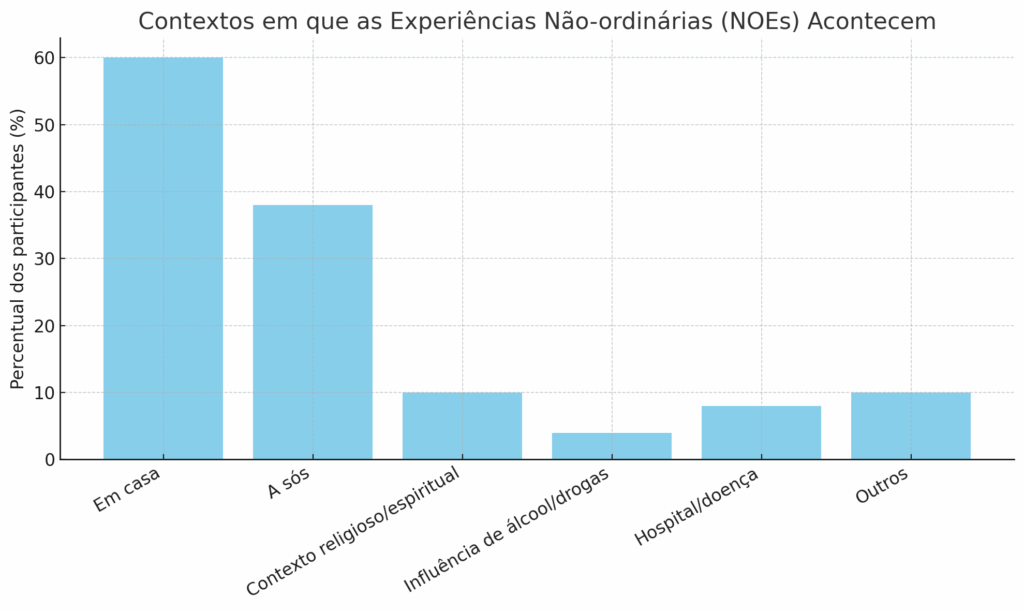
Contrary to what stigmas may suggest, such experiences do not necessarily occur in moments of fragility or mental confusion. More than half of the participants reported being awake and fully alert during the episode. Only a minority, about 4%, reported having experienced the event under the influence of alcohol or drugs. Moreover, in most cases, these were not episodes experienced in hospitals or situations of illness: most experiences occurred at home, in everyday life, often alone.
Other factors draw attention. About 38% of participants said they experienced the event when they were alone, raising questions about interiority and silence as fertile grounds for the extraordinary. Additionally, 10% reported having gone through this in religious or spiritual contexts, highlighting the role of culture and belief in how we interpret the unusual. In contrast, a similar portion stated that their experiences did not fit into any proposed category, suggesting that our vocabulary and interpretative models may still be limited in the face of the complexity of what is experienced.
AND HOW DO PEOPLE REACT TO THESE EVENTS?
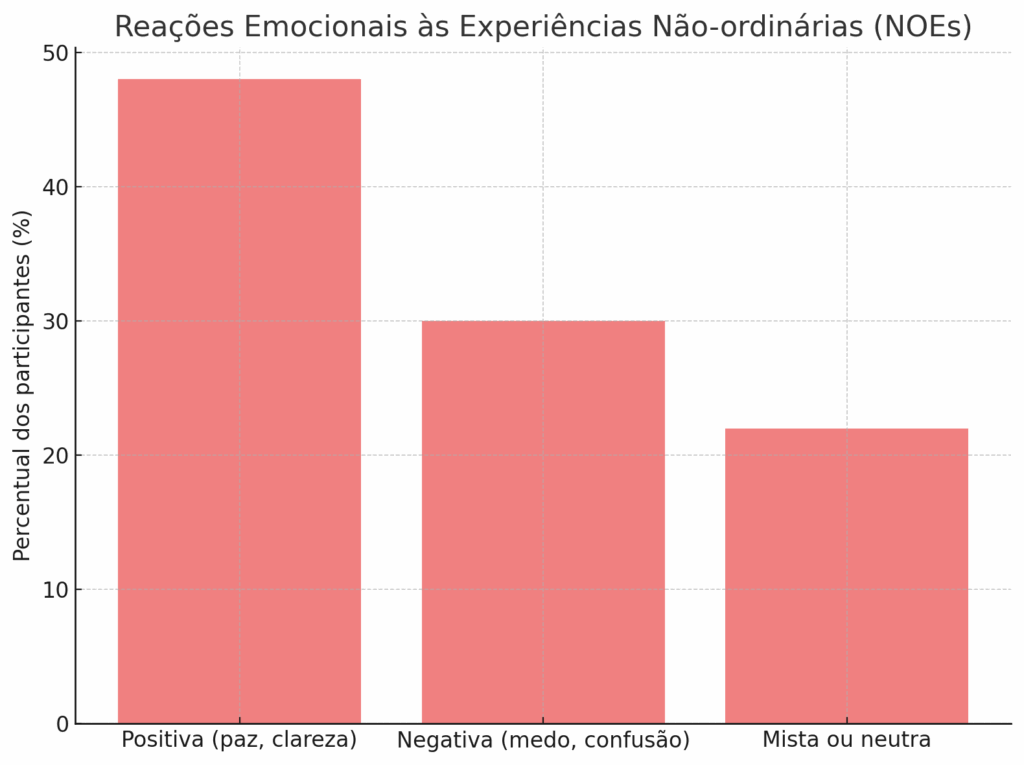
The answer is: it depends. For almost half of the interviewees, the feeling was one of joy, peace, or positive transformation. Many reported that the experience brought clarity, purpose, or reinforced personal values. On the other hand, a significant portion experienced fear, confusion, or suffering. These data show that the emotional impact is closely linked to the meaning that each person attributes to what happened. Those who believe they experienced a “divine sign” or a spiritual manifestation tend to react better than those who interpret the episode as something negative, pathological, or threatening.
This point, by the way, is central for researchers. According to the study, the way we interpret an extraordinary experience can determine whether it becomes a source of empowerment or a source of suffering. Culture, with its myths, religions, beliefs, and stigmas, shapes the lenses through which we see the invisible. And, in Brazil, where traditions such as Spiritism, popular Catholicism, and African-rooted religions coexist with scientific and secular discourses, there is space for both acceptance and judgment.
WHAT DO THE DATA REVEAL ABOUT THE PREVALENCE OF EXPERIENCES IN THE BRAZILIAN POPULATION?
The research identified a curious duality in the reports: approximately half of the people consider their experiences to have a spiritual or religious character. At the same time, almost the same proportion believes that science will one day explain what they experienced. This coexistence between faith and rationality seems to be a hallmark of contemporary Brazilian imagination, where the inexplicable does not need to be immediately excluded, only understood in another way.
Another relevant data point is the role of the community. For many, friends and family reacted positively or neutrally to the account of the experience. Few felt judged. This contrasts with what usually occurs in medical or psychiatric environments, where non-ordinary experiences are often seen as symptoms. Researchers therefore propose a review of clinical paradigms that still pathologize these experiences, ignoring their context, meaning, and function.
It is not to deny that certain perceptions may be linked to mental disorders. But the study shows that not every “strange experience” is a sign of illness. Often, it is an isolated, spontaneous event with symbolic or spiritual value for the person who experienced it. Ignoring this would impoverish the understanding of the human being in its complexity.
Within this scenario, a methodological question arises. In such a complex study with so many possible elaborations, how can we ensure that all participants understood what was asked in the inventory? Find out in the next article in the series.


