

By Pioneer Science | Published on June 26, 2025 | Last updated on May 14, 2026
First article in the series that explores the context of non-ordinary experiences in Brazil and how they impact our population. All data were collected and related from studies conducted by the Beliefs and Values Neuroscience group at the D´or Institute of Research and Education.
Authors Luiza Tavares and Giovanna Bortolini
Have you ever felt something you couldn’t explain? A presence in an empty room, a whispered voice with no apparent source, or an emotion so intense and sudden that it felt like it came from outside? These mysterious experiences, known in the neuroscience literature as “non-ordinary experiences,” are more frequent than one might think.
A series of recent studies with approximately 20 thousand Brazilians conducted by the Beliefs and Values Neuroscience Group at the D’or Institute of Research and Education (IDOR) and Pioneer Science has just shed light on a portrait of this phenomenon in our population. Some of the most relevant data obtained by the group will be shared on this site, starting now, through articles grouped by the main themes related to the results. Keep an eye on the publications. After all, this content might help you explain something that has happened to someone you know… or even to yourself.
HOW WERE THE STUDIES CONDUCTED?
With the support of the John Templeton Foundation and in partnership with Pioneer Science, the research interviewed people from all regions of Brazil to investigate situations and individual experiences that deviate from the everyday. Examples of some of these phenomena include overly vivid dreams, the sensation of completely losing track of time when focused on a task, visions of lights or figures without explanation, hearing voices, feeling guided by an invisible force, or the sensation of leaving one’s own body.
What differentiates this study from most of the literature in this area is that, instead of taking a clinical and psychopathological view of these cases, the researchers sought to understand what these experiences mean for those who live them and what impact, positive or negative, strong or mild, they have on people’s lives in the short and long term.
To this end, the Inventory of Non-Ordinary Experiences (INOE) was used, a tool originally developed by the team of American researcher Ann Taves from the University of Santa Barbara, California, in 2023. The INOE was designed to identify and describe unusual subjective experiences without preemptively assigning value judgments or clinical diagnoses. The version applied in Brazil was culturally adapted and expanded by the IDOR research team, which included items more relevant to the Brazilian context, such as experiences of mediumship, trance states, and transcendental emotions.
WHAT DO THE DATA REVEAL ABOUT THE PREVALENCE OF EXPERIENCES IN THE BRAZILIAN POPULATION?
According to the data collected by the adapted Brazilian version of the INOE, more than 50% of the research participants reported having lived at least one non-ordinary experience at least once in their lives. These experiences can be divided into conceptual groups that share some common characteristic.
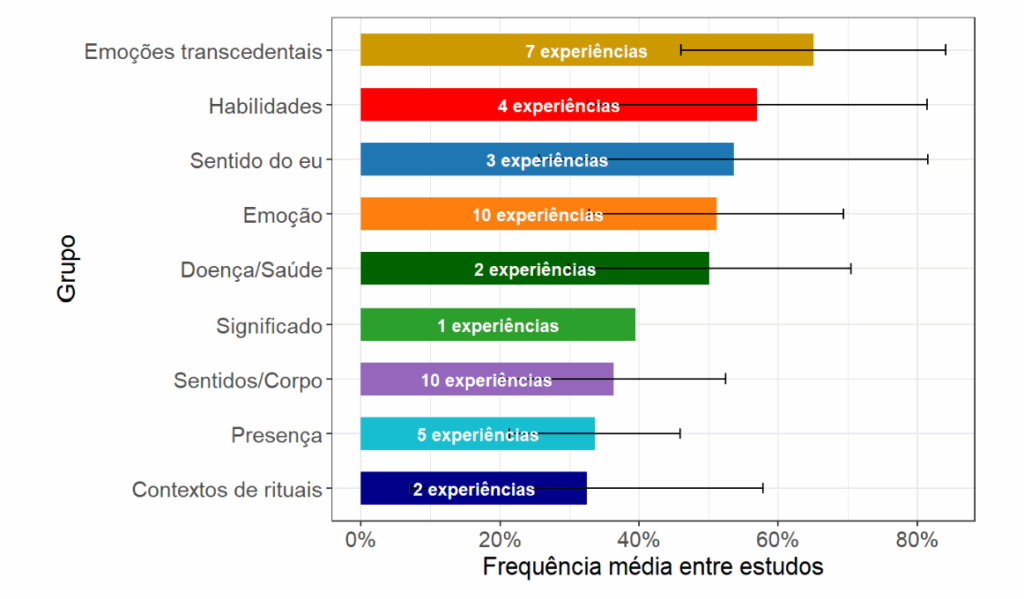
Among the groups, we have those experiences related to illness or health (2 experiences), to emotions broadly (10 experiences), and to transcendental emotions specifically (7 experiences). We also have groups related to so-called extraordinary abilities (4 experiences), the presence of something (5 experiences), alteration of the sense of self (3 experiences), alterations of the senses and body (10 experiences), specific ritual contexts (2 experiences), and the meaning or purpose of life (1 experience).
Taking a weighted average of the frequency of these experiences, it is interesting to note that the most frequent group is that of transcendental emotions, those emotional experiences so intense that they make us think about the well-being of others or feel part of something greater than ourselves. They can occur in the presence of something very beautiful, in a deep spiritual moment, during meditation, in nature, or even while listening to a touching song. The least frequent are experiences related to ritual contexts and the presence of a force or something. It is interesting to note that even in the less frequent groups, 1 in every 5 Brazilians has had experiences within those contexts. So, are they really that uncommon?
Overall, what this research suggests is that there is a very relevant and still little-explored territory in the studies of non-ordinary experiences in the Brazilian population. And that in this space may reside stories, emotions, and perceptions that, although invisible to the eyes of those who have never gone through something similar, can mark the trajectory of those who experience them.
Now, one question remains: what are the real impacts of these experiences and their unfolding? Is there any relationship that can be made between non-ordinary experiences and mental health? These questions guide the next articles in this series. Stay tuned.


