
By Pioneer Science | Published on October 10, 2024 | Last updated on May 14, 2026
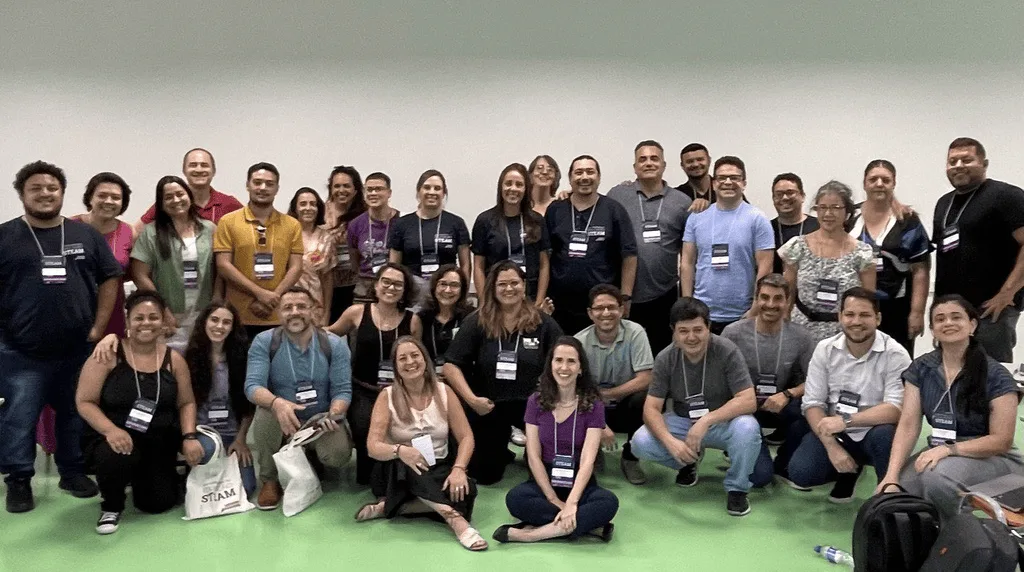
The philanthropic initiative coordinated four workshops during the National STEAM Education Meeting; The focus is to connect basic science to educators in elementary and high school
While teaching at the Free University of the Netherlands, Ana Clara Cassanti faced the challenge of integrating students from different countries and cultures. To solve this dilemma, she implemented the mixed-class model (see more below), which proved to be a success and which she carries with her to this day. Currently, Ana Clara is the education manager at Pioneer Science and had the opportunity to apply this methodology during the National STEAM Meeting, which took place from September 23 to 27.
The event brought together 250 science educators from all states of Brazil. Ana Clara conducted workshops for 100 of them, in order to raise their awareness about the importance of basic science for student development. The event was held at Inova USP, an innovation center on the Butantã campus of the University of São Paulo.
The goal of the meeting was to provide participants access to innovative teaching methodologies and strengthen scientific and technological education in public schools. In addition, educators participated in dynamics to develop an action plan adapted to each Brazilian state.
“Pioneer Science’s participation in this event was very positive,” evaluates Ana Clara. “We participated in a meeting that brings together educators and managers from public schools across Brazil. It is an important event for our education field, which aims to support low-income youth in accessing vocational and scientific education.”
For her, the mission of Pioneer Science’s educational actions goes beyond simply training scientists. The goal is to show that science is a means of transformation for young people’s lives, and that scientific literacy plays a fundamental role in student development.
The mixed-class model
Applied in the Pioneer Science workshop, the mixed-class model is structured in three phases:
1. Awareness
The initial stage aims to raise awareness among the participants and create a safe and welcoming learning environment. Here, interventions are made so that students see themselves as human beings with unique stories and difficulties, promoting empathy and understanding.
In the workshop, this phase began with the question of how the teacher-students felt. The responses were supported by a chart with photos representing different emotions, numbered from 1 to 12, so that participants could express their feelings.
Another awareness moment was the formation of participant groups to share the best compliment they had ever received. The responses varied, including compliments for helping with college entrance exam approval and even comparisons to beloved people and family members.
2. Engagement
The second phase aimed to stimulate constructive interactions among students. According to Ana Clara, even moments of disagreement, or “hot moments,” are conducive to strengthening collaboration and listening. In this stage, the focus was to reflect on the concept of basic science. By definition, it is the science characterized by the pursuit of knowledge for its own sake, regardless of its practical application. Thus, it is considered the “heart” of discoveries.
In this way, Ana Clara cited examples from various subjects taught by the participants to illustrate the impact of basic science on students’ daily lives. In mathematics, for example, number theory — little applicable at its inception — later propelled cryptography and computer science.
In addition to historical examples, workshop participants also shared their own memories. They discussed how much they enjoyed basic science when they were students and how basic science affects and contributes to daily life in their regions, precisely to align theoretical knowledge with life stories.
3. Optimization
In the last stage, the focus was on optimizing the learning experience through diverse perspectives. Inspired by the first step of the scientific method, participants were challenged to create a pre-research project that addressed relevant issues in their regions, using at least two basic sciences in an interdisciplinary manner.
Divided into groups, the teacher-students began with an observation exercise, reflecting on local problems they could solve in partnership with students. Additionally, they mapped the key actors involved, such as students, teachers, and funders, necessary to enable project proposals.
The groups then identified possible difficulties that could arise during execution, such as lack of resources. In the end, each group had the opportunity to present their pre-research project ideas to the other participants.
For Ana Clara, the results of the workshop were valuable and enriching. “Hearing the real needs of teachers from all regions of the country was inspiring to build more solid projects, with the potential to impact a significant number of educators and youth.”
She also highlighted the importance of encouraging persistence in students. “It is necessary to encourage them to continue in scientific initiation projects even when the results are not as expected. This approach helps to recognize the value of attempts and mistakes in the scientific process, especially in basic sciences.”
Challenges of science education in Brazil
A topic that permeated the discussions of the workshops at various moments concerns the difficulties of teaching and learning science in Brazil. There are several ways to understand this theme, including conducting national research and actively listening to teachers’ reports.
An example of the first approach is the research Panorama da Educação STEM no Brasil, conducted by the British Council, which reveals that only 33% of elementary schools have adequate infrastructure for science laboratories. Additionally, 57.5% of students at this educational stage in public schools are at the most basic levels of scientific literacy.
In the second, more personal approach, the account of Luisa Brasil Viana Matta, a biology teacher at the Federal Institute of Education, Science and Technology of Amazonas (IFAM), is revealing. She faces a daily challenge: the lack of interest from students, especially among high school students.
“I dedicate a lot of time to my classes, I spend days thinking about how to make them interesting,” she reports. “Sometimes, I arrive full of expectations, convinced that it will be a cool experience, but often that doesn’t happen. Even with varied activities, I notice that some students remain uninterested.”
Despite the difficulties, Luisa persists in presenting content about life science in attractive ways for teenagers. In fact, the workshop offered by Pioneer Science sparked a new source of inspiration. With experience in basic science, through her master’s degree in botany, she believes that this knowledge should be more valued in the school environment.
In her assessment, the workshop was extremely beneficial and practical. “All the stages were very interesting. I talked to people I had never met before, and suddenly we were sharing our life experiences. I finished the workshop energized and happy to have exchanged ideas with colleagues,” says the teacher.


