

By Pioneer Science | Published on July 18, 2025 | Last updated on May 14, 2026
Fourth article in the series that explores the context of extraordinary experiences in Brazil and how they impact our population. All data were collected and related based on studies conducted by the Beliefs and Values Neuroscience group at the D´or Institute of Research and Education.
Author Giovanna Bortolini
For some people, experiences like hearing their name being called when no one is around or seeing things that no one else can see may sound supernatural. For others, it may be a cause for concern about their mental health. But what if these experiences are, in fact, more common than we imagine and go beyond these interpretations? How should we as a society deal with these experiences?
As we saw in the last articles of the series, the INOE is a questionnaire that maps experiences that people consider unusual, striking, or outside their routine, without resorting to religious, supernatural, or clinical labels. This neutrality is central since the questionnaire was designed precisely to capture subjective phenomena. Within this questionnaire, experiences can be divided into conceptual groups and, in this article, we will address the group of experiences related to the senses of the human body, that is, those experiences that involve alterations, intensifications, or distortions in sensory perception such as vision, hearing, touch, smell, and proprioception.
WHAT DO THE DATA REVEAL?
When we look at the results, we see that 57.7% have heard voices, words, or sounds without an apparent source, 56% reported smelling scents without explanation, 49.9% felt they gained or lost energy from their body when interacting with certain people, objects, or entities, 44.7% have perceived faces in objects, 40% felt physical touches with no one around, 38.1% have experienced episodes of paralysis, where they cannot move their body, 24.4% have seen lights, glows, or luminous points without a clear origin, 21.7% saw things that other people around could not see, 18.8% felt that there was another being inside their body controlling their feelings and actions, and 14% reported having seen an aura around someone or something.
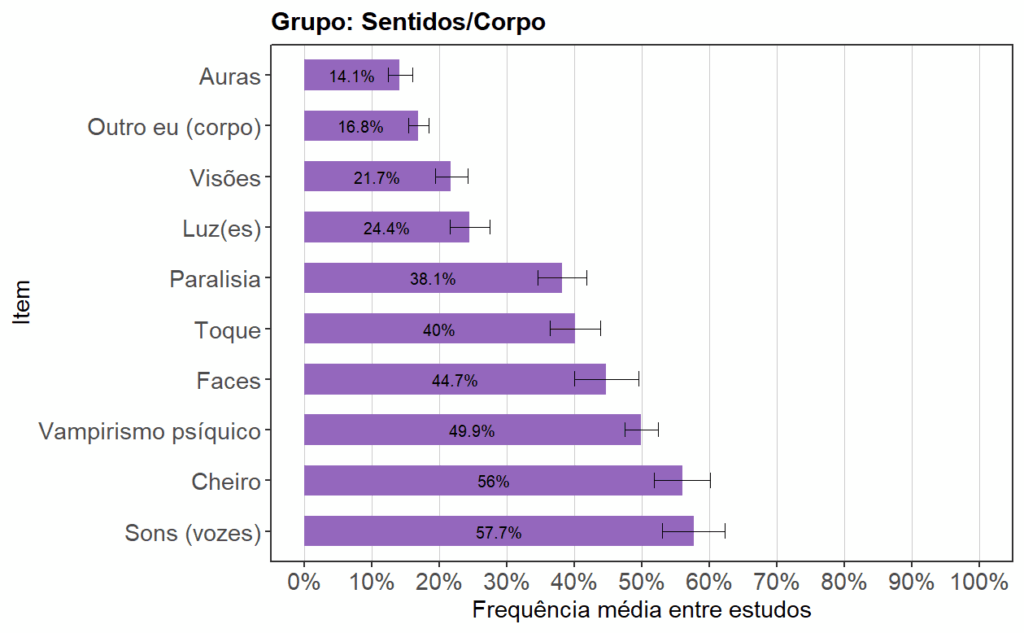
This data indicates that, far from being exceptions, extraordinary sensory experiences are part of the repertoire of a significant portion of the Brazilian population. Some more, others less. Even the less prevalent experiences like seeing auras or feeling another being inside the body were still reported by about 1 in 10 Brazilians, which is significant when we consider a broad population sample.
WHY IS THIS SO RELEVANT?
We live in a society that often associates the unusual with the pathological, the supernatural, or superstition. However, this study points to a more complex reality: having these experiences does not necessarily mean being ill, possessing a mediumship, or being delusional. Thus, they may escape these interpretations. For example, from an evolutionary perspective, such experiences may reflect natural adaptations of the human brain, from the increased ability to perceive environmental threats to mechanisms that favor social bonds and group survival.
This does not mean that these experiences are never associated with psychological suffering, and therefore, seeking professional evaluation when there is doubt or distress remains essential. But it also does not mean that, by themselves, these experiences are a sign of mental imbalance.
IMPACTS ON MENTAL HEALTH AND SOCIETY
This discovery has powerful practical effects. For mental health professionals, it means the need for qualified listening that is free of stigma. When someone reports, for example, that they feel touches without an apparent source, this should not be immediately interpreted as a symptom of psychosis, but rather contextualized culturally, biographically, and subjectively.
Well, now we know more about extraordinary sensory experiences. But can this data be applied to other groups of experiences? This question will be explored in the next article in the series. Stay tuned!


