

By Pioneer Science | Published on September 19, 2025 | Last updated on May 14, 2026
Tenth article in the series that explores the context of non-ordinary experiences in Brazil and how they impact our population. All data were collected and related from studies conducted by the Beliefs and Values Neuroscience group at the D´or Institute of Research and Education.
Author: Mirta Misailidis
Have you ever felt the presence of something or someone that wasn’t there? The sensation of some extraordinary force nearby or even the possible presence of a deceased loved one? The famous Non-Ordinary Experiences, also known as NOEs, can be classified into several types. One of them is having extraordinary abilities, such as sensing the presence of something or someone. Data collected by the Brazilian version of the Inventory of Non-Ordinary Experiences (INOE) indicates that more than half of the participants have experienced some type of Non-Ordinary Experience.
As described in the article 2 of the series “How non-ordinary experiences mark the lives of Brazilians”, about 60% of these experiences occur at home, 38% happen when the person is alone, and only 10% in religious contexts. Additionally, approximately 30% of people report having experienced some sensation of presence.
THE IMPORTANCE OF REPORTS
The search for explanations about the unknown and “out of the ordinary” experiences may seem appealing to many. And indeed, the cause of these phenomena remains a mystery. One way to study these occurrences more deeply and seek a possible explanation for their happening is through reports.
By describing their experiences, people who have gone through these experiences reveal different narratives, highlighting the diversity of sensations within the same group.
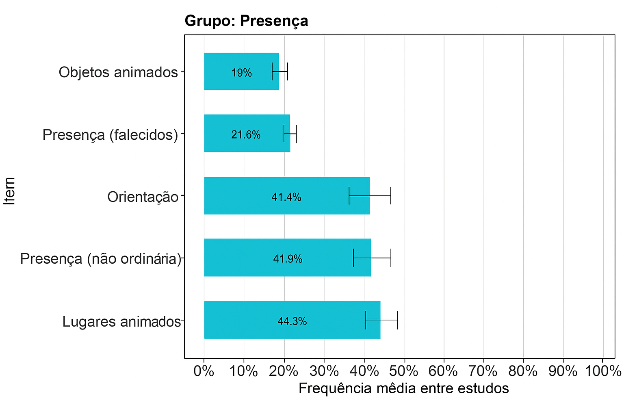
Specifically regarding the sensation of presence, five distinct types of reports have been identified. The figure below illustrates the frequency of different types of experiences involving the sensation of presence.
THE 5 TYPES
This experience can be differentiated into 5 main types, such as:
1. Animated objects:
Comprising 19% of the reported experiences, it can be described as a force or a higher being contained in images, statues, or objects that seem to have some special power.
2. Presence of deceased individuals:
With a frequency of 21.6%, this phenomenon can be described as the sensation of presence or communication with a deceased person, either directly or with the help of another person.
3. Guidance:
Being the third most common experience in the Presence group with 41% frequency of reports, it is described as a sensation where it seemed that some force, energy, or extraordinary being was guiding or influencing one’s own decisions.
4. Presence of something or extraordinary force:
41.9% prevalence, it is reported as the sensation that extraordinary beings or forces were around them. For example, in specific places, in objects or images, or from one’s own intuition or feeling.
5. Animated places:
In first place, with 44.3% prevalence, it is the sensation of being in a specific place that seemed to contain a presence, force, or extraordinary power.
WHY DO THEY FEEL THE PRESENCE?
But what leads some people to feel the presence of something invisible? Is this sensation just an illusion created by the mind? Professor and researcher at the University of California, Ann Taves, explains that this occurrence is shaped by a combination of factors. In one of her articles, she emphasizes that these phenomena are deeply shaped by cultural context and individual assessments.
The sensation of Presence, as the perception of “something invisible,” is also traversed by the cultural interpretative context, through which experiences are understood and given meaning. This factor not only shapes the interpretation after the fact but also influences the expectations and assessments that occur in real time, dictating how these experiences are perceived and valued.
Thus, depending on the situation, the same experience can be perceived as a spiritual sign, a religious manifestation, or even something negative for the individual’s mental health.
And you, have you ever felt something similar? Stay tuned for the next episodes to discover more about the new experiences of the INOE!


