
By Pioneer Science | Published on October 17, 2025 | Last updated on May 14, 2026
Article in the series that explores the context of non-ordinary experiences in Brazil and how they impact our population. All data were collected and related from studies conducted by the Neuroscience of Beliefs and Values group at the D´or Institute of Research and Education.
Author: Pedro Fortes
Moving further in the investigation of unusual experiences and mental states, based on the Inventory of Non-Ordinary Experiences (INOE), the Neuroscience of Values and Beliefs group at IDOR focused on psychic and paranormal abilities. As seen in previous articles, the Brazilian version of the INOE was validated by this same research group and contains 37 experience items organized into different conceptual categories. In the “psychic abilities” category, the following experiences are included: déjà-vu, lucid dreams, past lives, extrasensory perception (ESP), and seeing auras.
Whether temporarily or permanently, these abilities offer the individual the possibility of perceiving something that is commonly not perceivable. The experience of déjà-vu, for example, refers to the strange perception of having lived a certain scene before while it unfolds. In lucid dreams, one acquires the ability to remain aware during their own dreams and, most of the time, to control their plots and characters.
Experiences of past lives evoke in the individual the sensation of being able to access memories from a previous life, sometimes with rich details and strong emotional content. ESP, on the other hand, involves precognitive abilities – that is, the individual predicts future events that become reality some time later. There is also a substantial number of individuals who report the ability to see auras around other people, like halos of light around their heads or bodies, commonly claiming the ability to extract information about physical, mental, and spiritual health through these visions.
PREVALENCE DATA
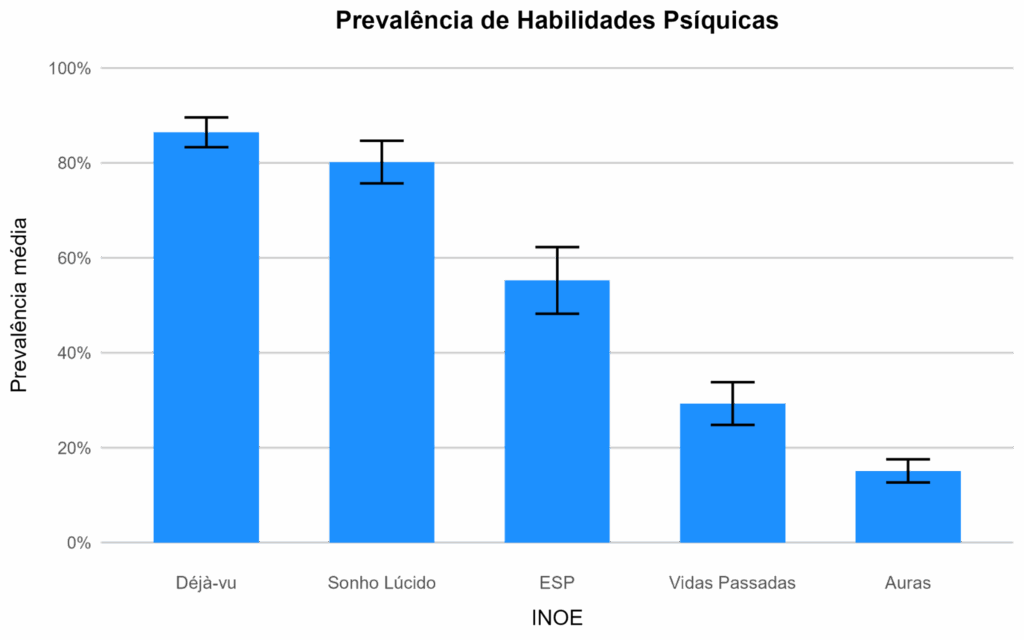
Image 1. The bar chart indicates the average frequency among the combined participants of the 6 studies for the experiences of “Déjà-vu,” “Lucid Dream,” “Extrasensory Perception” (ESP), “Past Lives,” and “Auras.”
The average prevalence of these experiences in the Brazilian population was estimated from data obtained with 6 distinct samples. The experience of déjà-vu was the most prevalent among the 37 experiences in the inventory, being reported at least once in life by 86.45% of participants and more than 10 times in life by 25.37%.
Regarding the experience of lucid dreaming, 80% of participants report having experienced it at least once and 18% more than 10 times. The experience of ESP, although very prevalent (55.24%), stood out in the group as the one that occurs least frequently throughout life, with only 5% of participants reporting it more than 10 times.
More uncommon, the experience of past lives was reported at least once by 29.28% of participants, and 2/3 of these reported having experienced it a maximum of 3 times throughout their entire life. Finally, the experience of seeing auras was the rarest in the group and also among all experiences in the inventory, with an estimated prevalence of 15.10% and only 1/4 of these participants reporting it more than 3 times in life.
IMPACTS ON HEALTH
It is known that individuals who report this type of experience often demonstrate psychological traits associated with fantasy, dissociative experiences, and a higher level of absorption in mental, sensory, and imaginative processes. These psychological characteristics make the individual more prone to experiencing, valuing, and interpreting these experiences in a meaningful way.
Interpretations may involve metaphysical and paranormal explanations or fundamentally materialistic and scientifically oriented perspectives, and will be largely determined by the sociocultural context and the person’s belief and value system.
Some authors advocate the hypothesis that experiences of psychic ability such as ESP or seeing auras may offer a greater sense of control and mastery over the environment, especially for individuals in unstable environments or with a history of exposure to traumatic events. In this case, it is possible that these experiences have adaptive value when interpreted positively and integrated into the life context of those who report them.
On the other hand, experiences such as déjà-vu and the perception of past lives may be understood as “paramnesias” – distortions in memory processing – and may be manifestations of neurological changes when they begin to occur frequently. In this case, it is important that they be investigated by a clinical professional.
In the upcoming articles, we will explore more deeply the association between non-ordinary experiences, their interpretative dimension, and mental health. Until next time!


